
Our History
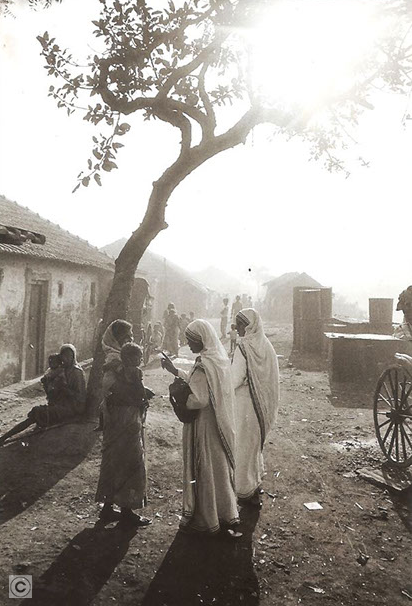
“Our Lord wants Indian nuns, victims of His love, who would be so united to Him as to radiate His Love on souls – who would lead Indian lives, dress like them, and be His light, His fire amongst the poor, the sick, the dying, the beggars and the little street children.” ~ Mother Teresa
On 10 September 1946, Mother M. Teresa (a Loreto nun at a time) received an inspiration from God to found a new congregation devoted to the service of the poorest of the poor. After obtaining the approval of the Archbishop of Calcutta, Ferdinand Perier, S.J., and the permission of Holy See (Vatican), Mother Teresa left the Loreto convent in August 1948 to begin her new work among the poor in the slums of Calcutta. The first 12 young women, most of whom knew her as she had been their teacher and head mistress, followed in her footsteps and soon become known as the “running congregation” in Calcutta slums. On 7 October 1950, Archbishop Perier, S.J. erected the Missionaries of Charity as a diocesan congregation, for the Archdiocese of Calcutta. Mother Teresa began to visit the poorest of the poor in their homes and on the street, to care for the sick and the dying, and to gather and teach little street children. She opened slum schools, medical dispensaries and food distribution centers. In 1952, Mother Teresa opened “Nirmal Hriday” (Immaculate Heart), the first home for the dying destitutes; in1955, she opened “Shishu Bhavan” the first home for the abandoned children and in 1957 the first mobile leprosy clinic. Her first mission outside Calcutta was in Ranchi in 1959. Throughout the 1950s and early 1960s, Mother Teresa expanded the work both in Calcutta and throughout India. In 1965 when she and her “little band” courageously embarked on a first mission “abroad” in Cocorote, Venezuela; very soon followed foundations on all five continents. At the time of Mother Teresa’s death in 1997, there were 3914 sisters in 594 missions in 123 countries Various works developed as she endeavored to meet the needs of the poorest of the poor around the world. In time it included homes for them, those who had TB, those physically and mentally challenged, those suffering with various mental illness, AIDS patients, night shelters, soup kitchens, homes for the unwed mothers and mothers with children in difficulties, afterschool programs and summer camps for the children from the poor families, and so on.
