
Mother Teresa, Our Foundress
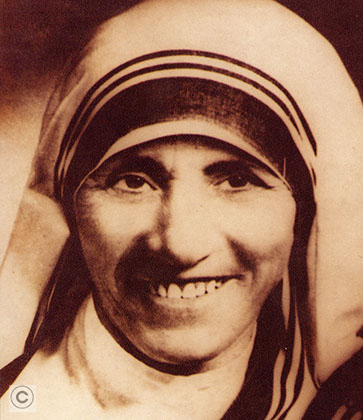
Mother Teresa of Calcutta
"By blood and origin I am all Albanian.
My citizenship is Indian.
I am a Catholic nun.
As to my calling,
I belong to the whole world.
As to my heart,
I belong entirely to the Heart of Jesus.”
The future Mother Teresa of Calcutta, was born in Skopje, present day North Macedonia, on 26 August 1910 and baptized the following day, 27 August. She was the youngest of five children, two of whom died in infancy. Gonxha’s parents, Nikola and Drana Bojaxhiu, provided a loving home for their three children. The prosperity and security of their family life was cut short, by Nikola’s sudden death in 1918. At the age of twelve, Gonxha felt a call to serve the poor and at 18 she decided to join the Institute of the Blessed Virgin Mary (Loreto nuns) in Ireland with the intention to serve in India.
Gonxha left her home in September 1928, and upon arrival at Rathfarnham Abbey was given the name Sister Teresa. In December 1928 she departed for India, and arrived in Calcutta, on 6 January 1929. After two years of novitiate in Darjeeling, Sister Teresa made her First Vows in May 1931. She was assigned to the Loreto Entally community in Calcutta and taught at St. Mary’s Bengali Medium School for girls. In May 1937, Sr. Teresa made her final profession as a Loreto nun and from then on was called Mother Teresa. She reassumed her duties at St. Mary’s, and in 1944 became Principal of the School. Mother Teresa was noted for charity, unselfishness, courage, a capacity for hard work, a natural talent for organization, and a joyous spirit. Somewhat fragile she did not enjoy good health in those years.
On 10 September 1946, on the way to Darjeeling for her annual retreat, Mother Teresa received what she would name the “call within a call.” Over the course of the next months, by means of interior locutions, Jesus asked her to establish a religious community that would be dedicated to the service of the poorest of the poor. She exposed her Inspiration to the scrutiny of her spiritual director and to the discernment of Archbishop Périer. Both after much prayer and reflection allowed her to take the new step.
In August 1948 Mother Teresa left Loreto convent, Entally and went for a short Medical Training with the Medical Missionaries in Patna. Returning to Calcutta in December 1948, she took lodging with the Little Sisters of the Poor and started her work in the slums, visiting the sick, gathering and instructing little street children, and gradually opening her first slum school and dispensary in the Motijhil slums. The challenges and sufferings of those early days were really great, but she persevered in following God’s call. God rewarded her great sacrifices with vocations, benefactors and a flourishing mission. On 7 October 1950, the new congregation of the Missionaries of Charity was officially erected as a religious institute in the Archdiocese of Calcutta.
In order to meet the various types of poverty that she encountered as her mission was expanding, besides the Missionaries of Charity Sisters, Mother Teresa initiated the Missionaries of Charity Brothers in 1963, and in later years the contemplative branches (Sisters and Brothers) and the branch of priests. From the beginning of her mission among the poor, a great number of lay people shared in her work, and eventually consolidated into an International and Inter-religious association known as “The Co-workers of Mother Teresa.”
Despite her age and increasing health problems, Mother Teresa travelled across the world serving the poor and disaster-stricken, opening new houses where need aroused. She was also invited to speak at innumerable public gatherings.
On 5 September, she died at the Mother House of the Missionaries of Charity in Calcutta. Her body was transferred to St Thomas’ Church, next to the Loreto convent where she had first arrived nearly sixty-nine years earlier. Hundreds of thousands of people from all classes and all religions, from India and abroad, paid their respects. She received a state funeral on 13 September, and after processing through the streets of Calcutta, was buried in the Mother House of the Missionaries of Charity. Her tomb became a pilgrim site and a place of prayer for people of all faiths and walks of life.
On 19 October 2003 Pope John Paul II declared her ‘Blessed Teresa of Calcutta’, and on 4 September 2016, Pope Francis declared her ‘Saint Teresa of Calcutta’, thus placing her among the Saints of the Catholic Church. For the poor, for children, for all who knew and loved her and who pray to her, she continues to be “Mother”.
The Missionaries of Charity continued to grow after Mother Teresa’s death. In 2025 there are 5076 Sisters in 754 missions in 138 countries continuing Mother Teresa’s legacy and giving wholehearted and free service to the poorest of the poor.
Mother, as seen by others
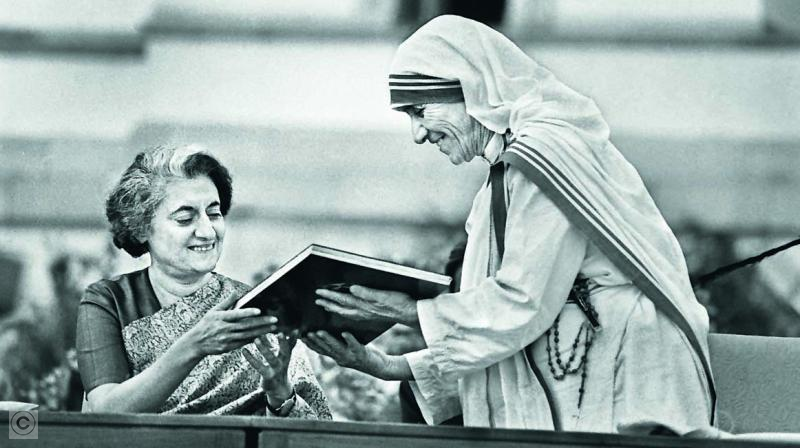
Indira Gandhi
… St. Francis’ beautiful and well-loved prayer… eloquently epitomises the gentleness, the love and the compassion that radiate from Mother
Teresa’s tiny person. Who else in this wide world reaches out to the friendless and the needy so naturally, so simply so effectively? Tagore wrote “there rest Thy feet where live the poorest, and lowliest, and lost”.
That is where Mother Teresa is to be found – with no thought of, or slightest discrimination between colour or creed, language or country. She lives the truth that prayer is devotion, prayer is service. Service is her concern, her religion, her redemption. To meet her Is to feel utterly humble, the power of tenderness, the strength of love.
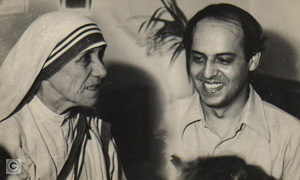
Navin Chawla
Mother Teresa…was hardly Albanian any longer. I knew that she had taken Indian citizenship soon after Independence in 1947 and that she spoke Bengali fluently. Long years of working in the slums of Calcutta and elsewhere in India had rendered her as Indian as anyone in her adopted country. It was her hands and her feet, however, that betrayed her arduous life.. Over the years I have often cast my mind back to that morning [when I first met her]. What was it that had made it so special? Was it that her self-effacing presence had scaled down the grand chamber in which we sat to her kind of ordinariness? Was it the sari, darned neatly in several places, or the old cloth bag with wooden handles which she carried that contributed to her sense of humility? Perhaps it was all “, as well as the enchantment that clung to her because she had lived so closely with her God.

Desmond Doig
Mother’s people are the poorest of the poor, be they in India, where her work began, or in the affluent countries of the world to where it has spread. Her work, shared by a growing number of Missionaries of Charity, is to give help and love where it is needed. The Brothers and Sisters of the Order are today working in the ghettos of New York, the slums of London, in Australia, South America and in the shadow of the Vatican at the Pope’s personal request. Mother Teresa maintains that the suffering of the poor in affluent countries is more a searing loneliness and rejection. In India, strong bonds of family, religion and tradition lessen the rigours of poverty, but it is still there, a product of history, geography and exploding population.
